In Memory of Dolly Parton: A Life Run on the Sacral Yes
Dolly Parton was a 4/6 Sacral Generator on the Incarnation Cross of Laws. A look at the sacral yes behind Wagoner, Dollywood, and the Imagination Library, and the four returns that marked out the shape of her life.

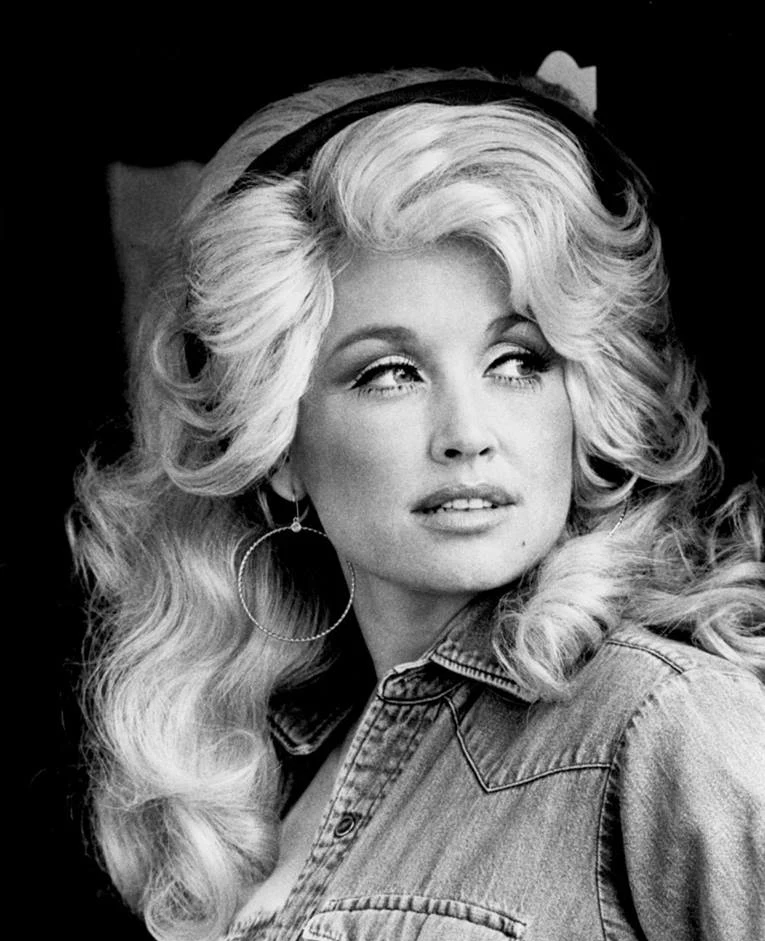
Dolly Parton, 1977. Photo: RCA Records.
Dolly Parton died August 25, 2026, in Nashville. She was 80, and the world feels a little less bright tonight without her in it. I have tears in my eyes writing this, and my body feels the ache of pain and loss in the center of my chest with a burning sensation. As usual with death, I don’t feel comfortable holding news like this. So I’m going to do the thing I know how to handle well: look at the beauty of a life lived well from the frame of human design.
Even though I grew up in Hawaii, as far away from Nashville, Tennessee as you could get and still be in the good old US of A, I, like everyone in my generation, knew about Dolly Parton.
Her most-used chart uses an AA-rated record: January 19, 1946, 8:25 PM, Sevierville, Tennessee. I want to be straight about what that rating does and doesn’t settle. Her birth certificate itself carries no time. Astro-Databank’s own biography note has her father recalling 3:00 AM, and Parton herself has told interviewers the same, “I was born at three in the morning, so my mother says.” The 8:25 PM figure is the one most astrological databases now carry with an AA rating, from a birth record separate from the certificate, and it’s the time this piece works from. Type and Sacral Authority hold steady across a birth window that wide; profile lines and Variables would not survive a seventeen-hour shift untouched. I’m naming the uncertainty rather than pretending the data is cleaner than it is.
Run the 8:25 PM chart and here’s what comes back:
| Type | Generator |
| Strategy | Wait to respond |
| Authority | Sacral |
| Profile | 4/6 |
| Definition | Single |
| Cross | Right Angle Cross of Laws (60/56 | 50/3) |
| Signature / Not-Self | Satisfaction / Frustration |
| Data | AA record, 8:25 PM CST, Sevierville, TN |
I’ve written a separate article over on my HumanDesignBusiness.com site if you’re more interested in her Human Design for work snapshots. This one is the personal side.
None of that explains a life. But it rhymes with one, and I want to walk through the rhyme tonight the way I actually teach it, fixed mechanics read against the moving transits that marked out the turns her life actually took. Four returns, four ages, one design underneath all of them.
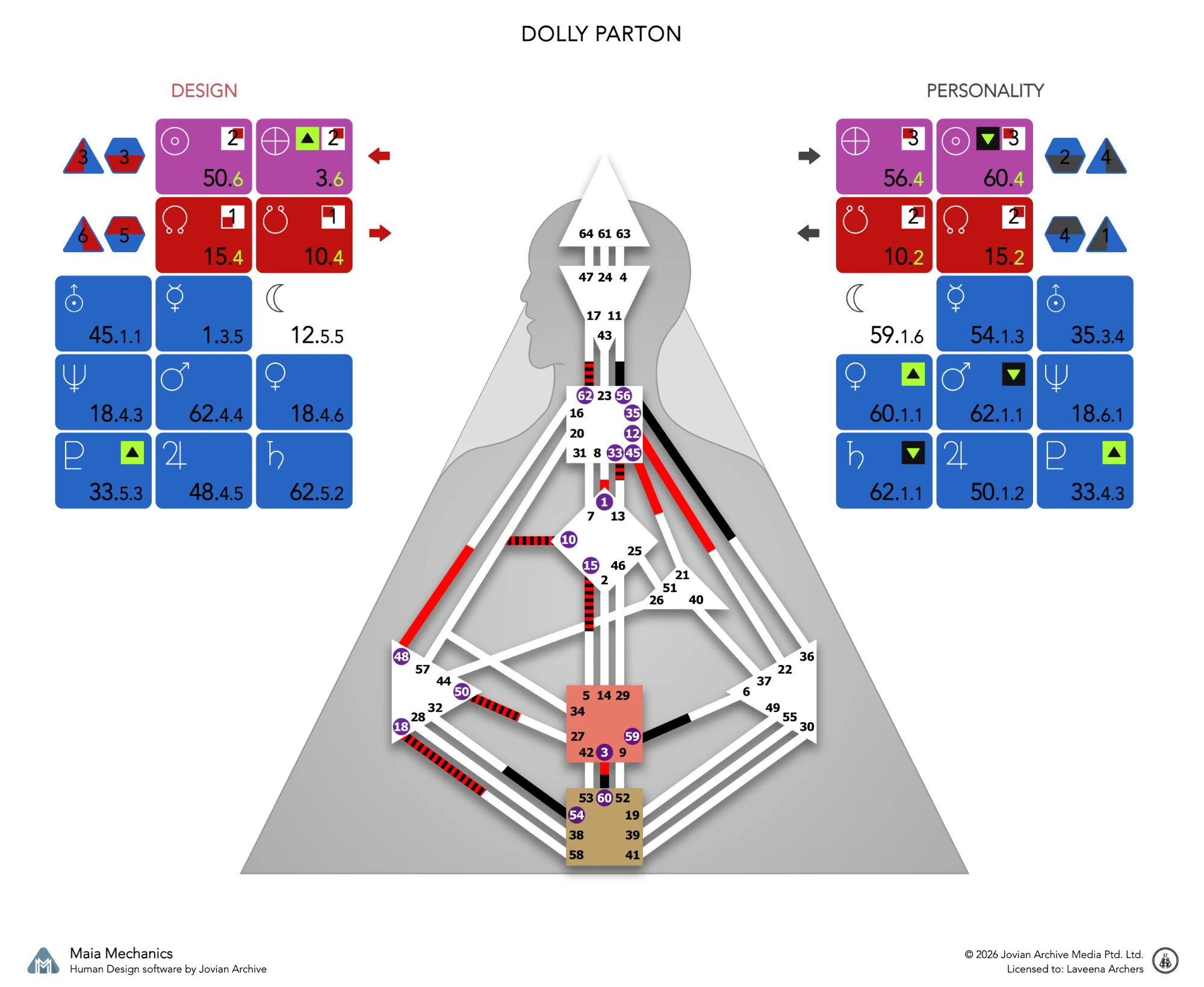
Dolly Parton’s natal bodygraph, 4/6 Sacral Generator: Design and Personality, activated at birth.
Each of the four transits below carries its own layer on top of the natal chart: its own profile, its own cross, its own cast of people and circumstances riding alongside hers. That’s the actual reason the chart image sits at each cycle instead of just being described in prose. It’s there so students of Design can look at what’s actually on the page rather than take my reading of it on faith. One detail worth noticing on your own: every one of these four transit charts carries a 6th line profile, except her first Saturn Return, which reads 1/3.
I find it telling to look at the cross profiles to see the new costume being worn for that time of life on top of the natal design. It’s helpful to understand the development of your core character and movement towards purpose or fulfillment of purpose depending on the cycle we are analyzing.
The gut that never doubted itself
A Generator’s whole mechanism runs on response before initiation: the body says yes or no before the mind has finished its sentence, and the life that trusts that response is the life that has energy for it. With Solar Plexus undefined, Sacral Authority means the gut decides and the emotions ride along behind it. An undefined Solar Plexus also takes in whatever emotional weather is in the room rather than generating a consistent one of its own, which is a strange thing to carry through fifty years of public life: feeling the audience’s mood before you can name your own, then handing it back as a three-minute song sturdy enough for someone else to survive inside. I won’t call that empathy dressed up as a superpower. It’s a mechanic, and it’s a demanding one.
She lived the Sacral half of this in public, more than once, and the clearest instance is also the best documented. Porter Wagoner put her on national television in 1967, twenty-one years old, on a syndicated country variety show that made her a name before her own material ever got the chance to. Seven years followed: hit duets, a steady paycheck, a mentor who had discovered her and never quite let her forget it. By the early 1970s the relationship had curdled into something closer to control than partnership, and everyone around her could see it before she said so out loud.
One complete unit
Single Definition means the whole chart connects as one piece, with nothing needing an outside person to complete it. A Single Definition Generator doesn’t need a partner to feel whole; she needs someone worth responding to. That’s a different foundation for a career than most performers get to work from, and it’s the same foundation that lets someone build an empire alone once the partnership that made them stops wanting to grow with them.
Gate 62, in the Throat, is the gate of exact, unglamorous detail. It’s the voice built for compressing a whole life into a line simple enough that a stranger can carry it: “If you don’t like the road you’re walking, start paving another one” is that voice at work, and so is most of what got quoted about her this week. By her own account she kept a fixed rhythm for fifty years: awake before dawn, writing before anyone needed her to be anything else yet. That routine sits right where her chart says it would: her Personality Saturn is Gate 62 line 1, literally named Routine, the same gate her Saturn Return would spend the rest of this piece auditing. I recognize the shape of it in my own life too, from a different gate; there’s a particular quiet to the hours before dawn that the rest of the day never quite offers back. It’s when I get my own most important work done. Her catalog reads like the sacral archive that rhythm produced, Coat of Many Colors turning a childhood coat into a testament, Jolene turning a single fear into three minutes nobody has stopped covering since, 9 to 5 turning a workday grievance into an anthem people still know every word of. Who else remembers the song “9 to 5”?
Gate 32, in the Spleen, senses what has staying power and what doesn’t. It’s the instinct behind founding things built to outlast a single hit record, which is exactly what came next.
Single Definition in public
A Single Definition chart is already whole. It doesn’t need an outside tribe, a party, or an institution’s approval to feel complete, and hers ran that way in public for fifty years around the one subject most public people eventually get pulled into: politics. She said it often and directly, that she had about as many Republican fans as Democrat ones and had no interest in offending either side, describing her own household as the reason why: her father was a Republican, her mother a Democrat, and she was, in her own word, a “hypocrat.” When a 2016 New York Times interview quoted her saying a woman would do a great job as president and that Hillary Clinton was “very qualified,” reporters read it as an endorsement. She corrected that within days: she hadn’t endorsed either candidate, hadn’t decided who she was voting for, and the quote had been taken out of context.
The clearest example came later. In a February 2021 Today interview, she said she’d twice been offered the Presidential Medal of Freedom under the Trump administration and turned it down both times, once because her husband was ill, once because she wouldn’t travel during COVID. The Biden administration had since reached out too. Her reasoning for holding off on that one was direct: “if I take it, it’ll be doing politics, so I’m not so sure.” Not a statement about either administration. Just the same gut response that ended a publishing negotiation in 1975, applied to a national honor instead of a song.
That’s a Sacral no arriving on contact, not a position worked out in advance, and a Single Definition chart doesn’t need the argument finished before it trusts the response. She held that line for decades, through co-stars, interviewers, and enough opportunities to say more than she chose to. What she built with the years that freed up is the more permanent record.
The profile that took its time
A 4/6 profile lives two different lives. The fourth line builds through the people already around it, friendship functioning as the actual infrastructure of a career. The sixth line spends its first three decades learning by doing, much of it in public and some of it in error, then climbs onto the roof to watch for a long stretch, and only later becomes something the culture points to as an example rather than a performer to critique. That roof period generally opens around fifty, and hers opens almost exactly on schedule: the Imagination Library founded in 1995, the year she turned forty-nine, then a public decade running less on new material than on being trusted, Book Lady, Kennedy Center honoree, a name attached to a vaccine she filmed herself taking on camera because she wanted people to trust the shot too. Students remember that kind of timing longer than they remember gate names.
The Cross of Laws
One of the most common charts I get to read is the Cross of Laws. I still remember fondly one of my Human Design teachers looking at a chart of my first Cross of Laws client in 2013, in preparation for a session, as a new Living Your Design Guide.
Her Cross of Laws isn’t about fixing anything. Dolly’s was a job of the guru, bringing hope: the transpersonal work a life ends up doing whether or not the person signed up for it consciously. The Cross of Laws runs through Gates 60, 56, 50, and 3, and its job is establishing structure other people can actually live inside after the person who built it is gone: a code, a standard, a set of terms the community can build on. Each gate carries its own piece of that job. Gate 60, in the Root, is the pressure to accept a real limit as the price of real change. Gate 56, in the Throat, is the storyteller who turns raw experience into a narrative people actually stay with, someone else’s experience as often as her own. “Travelin’ Thru,” written for the 2005 film Transamerica and drawn in part from a transgender relative in her own family, is that gate at work on material that wasn’t hers to begin with: she took someone else’s life, found the through-line in it, and handed back a song specific enough that the Academy and the Golden Globes both nominated it. That’s Gate 56’s actual job description, not a stance, a translation. Gate 50, in the Spleen, guards what a community needs to keep in order to stay well. Gate 3, in the Sacral, brings workable order out of whatever is just beginning. Run together, that’s a custodian’s chart, someone keeping track of what matters whether or not they ever asked for the job.
The specific lines sharpen it further. Her conscious Sun sits on Gate 60’s fourth line, Resourcefulness, the version of accepting a limit that goes looking for what can still be built inside it rather than what the limit is taking away. Her design Earth sits on Gate 3’s sixth line, Surrender, the maturity to recognize when a struggle has stopped being useful and let it go. Between those two lines is most of what this piece is about to describe: working inside real constraints without resenting them, and knowing exactly when continuing to fight a losing structure, a partnership, a diagnosis, stops being strength and starts being waste.
Channel 3-60
One channel in her chart does more of this article’s actual work than any single gate does on its own. Gates 3 and 60 aren’t just two of the four Cross of Laws gates. They’re also the two ends of the same channel, both activated in her design, which means the channel itself is defined: Channel 3-60, the Channel of Mutation, running from the Root’s pressure straight into the Sacral’s own generative force. It belongs to the Individual circuit, the part of the bodygraph built to produce difference rather than agreement, and its signature is a pulse rather than a current. It fires, then goes quiet, then fires again, and nothing, not a deadline, not willpower, not sheer discipline, can force it to run on someone else’s schedule.
That is close to a mechanical description of everything the rest of this piece is about to walk through. A Sacral no that arrives instantly and then takes a year to finish closing. A partnership that runs seven years and then ends in a single season. A theme park nobody would have greenlit on paper, built anyway. A literacy program founded the year before a Chiron Return that would go on to confirm it. Each of those looks, from the outside, like patience or timing or good instincts. From the inside, it reads more like a pulse doing exactly what a defined 3-60 does: staying silent until the pressure is real, then changing something permanently in one motion.
Saturn Return, 1975
Saturn returns to its own natal position roughly every twenty-nine years, and the return itself is less a mood than an audit: whatever structure in your life was never built to last gets tested right about now, and either holds or doesn’t. Hers didn’t. Her natal Saturn sits in Gate 62, Details, in the Throat, so the audit ran through exact, factual language instead of a drawn-out public feud: an announcement, a last date, a goodbye song that stated the thing outright.
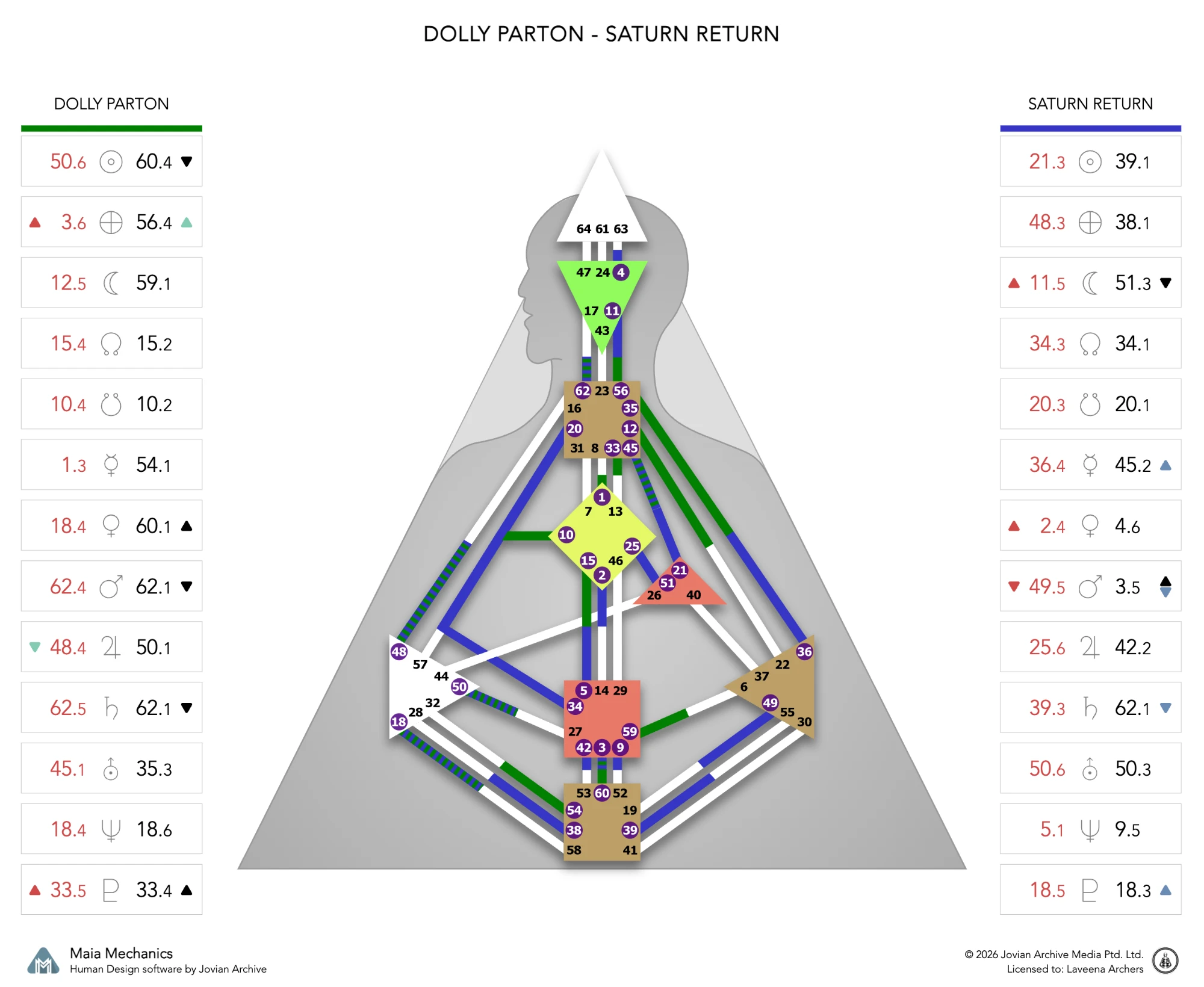
Natal chart against the July 1975 Saturn Return transit, age 29: the Wagoner partnership finishes closing.
She announced she was leaving Wagoner’s show in February 1974, kept a promise to finish out the season, and played her last date with him that April. It took until July 1975, almost exactly on her first Saturn Return, for the final joint album, Say Forever You’ll Be Mine, to release and the professional relationship to actually finish closing. Nobody argues that a person waits until a specific transit to end something. But a Sacral response doesn’t announce its timeline either; it just tells you when the ground under a thing has become load-bearing versus decorative, and hers had been telling her that for a while by the time Saturn caught up with the paperwork. Around the same window, she turned down an offer from Elvis Presley’s camp to record “I Will Always Love You,” a song she’d written about Wagoner himself, because his people wanted half the publishing. Whitney Houston’s cover, nearly two decades later, turned that no into one of the best-paid decisions in music history.
Neither choice was strategy on paper. Both were a Sacral yes and a Sacral no, trusted at the moment they arrived, worked out afterward.
At twenty-nine, she was still fully inside the trial-and-error stretch a 6th-line profile lives through before the roof, learning what a partnership actually costs by living inside one. The steady 4th line underneath that testing had built her entire career through one relationship, Wagoner discovering her and carrying her onto television, and that is exactly the 4th line’s real vulnerability: influence that travels through the people already around you can travel out just as easily as it travels in, once those people stop wanting to grow with you. Even her image up to that point had been partly his: the modest western dresses, the girl-singer wig, a look shaped as much by his show as by her own hand. Leaving meant choosing her own costume for the first time too, alongside her own material. The Cross of Laws hadn’t found its public shape yet at 29. But the mutation underneath it, the on/off pulse of Channel 3-60, was already doing its actual work: a clean break, decided fast on gut instinct rather than argued into being, then given a year to settle into something permanent instead of dissolving.
Uranus Opposition, 1984
Uranus takes eighty-four years to complete a full circuit, so its first opposition to itself falls in early midlife, usually the loudest, most disruptive transit a chart sees before sixty. It has a reputation for breaking things and shaking things up. I tend to call this time of life our mid-life crisis, because it truly can be. It’s just as often the transit under a reinvention nobody saw coming.
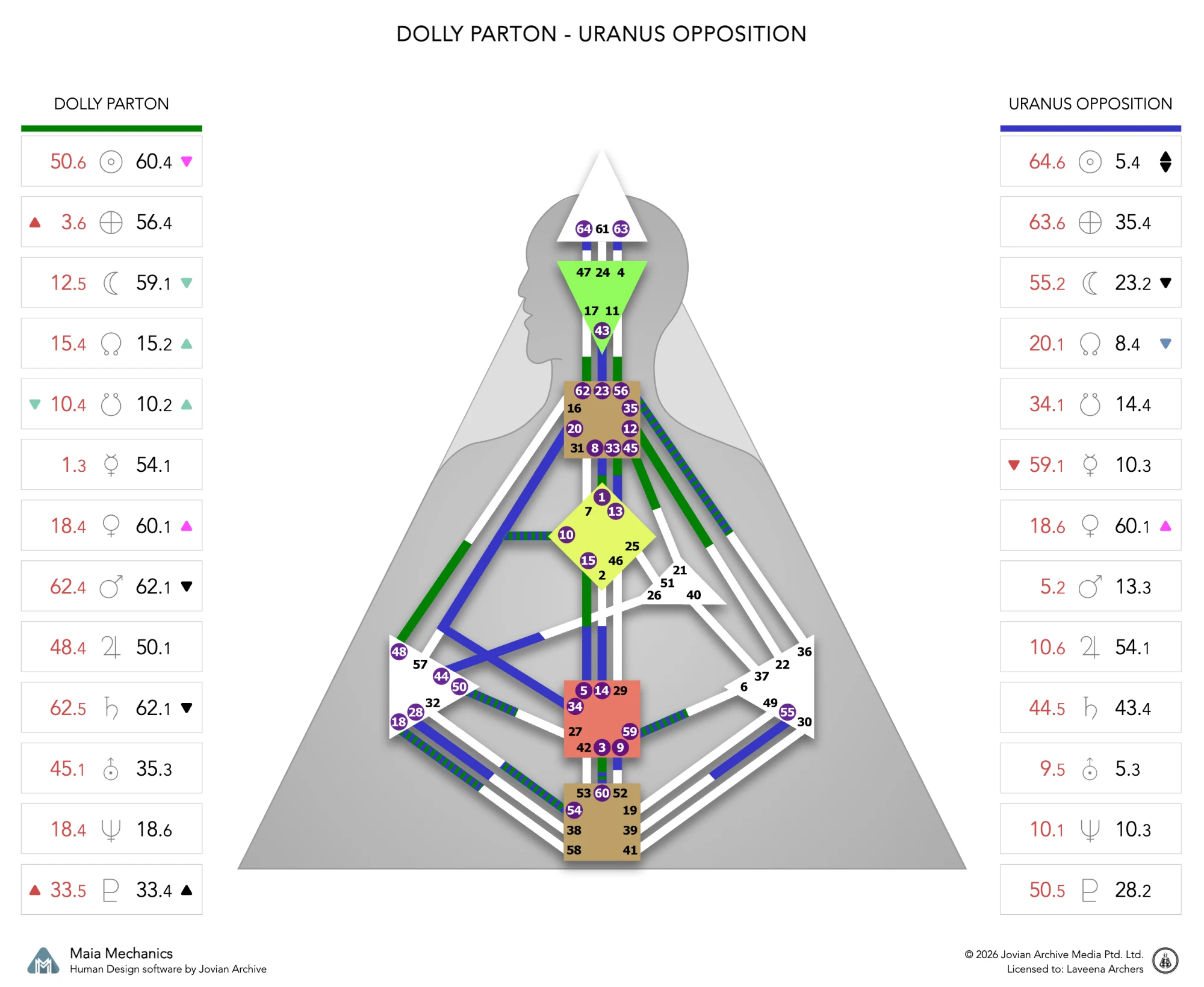
Natal chart against the December 1984 Uranus Opposition transit, age 38: the midpoint of the Dollywood arc.
In 1982, a television interview caught the attention of Pete and Jack Herschend, who ran a modest theme park outside her hometown called Silver Dollar City. The connection ran through people, not agents: her own bus driver knew the park’s general manager, who knew the Herschends. That chain became a partnership, and the partnership became Dollywood: a rebrand of a regional attraction into a park carrying her own name, in the county she’d grown up poor in, the agreement signed in 1985 and several million dollars of her own money going into expanding it around the rides that were already there rather than starting over. Her natal Uranus sits in Gate 45, the Gatherer, the gate of pulling already-existing resources and people together rather than starting from nothing, and December 1984, her Uranus Opposition almost to the day, sits at the rough midpoint of that arc: a chance conversation gathered into an actual signed deal, a park with a season and a calendar. It reopened as Dollywood in May 1986. It is the least likely business move on this list on paper, a country star putting her name on a theme park in rural Tennessee, and it became one of the most durable things she ever built. That’s Uranus for you: the break that turns out to be the opening.
By thirty-eight she was nearing the end of that same trial-and-error stretch, close enough to the roof to be gathering the last of the raw material she’d spend the next phase making sense of. The 4th line ran this whole chapter: a television interview seen by the right two brothers, a conversation that became a partnership because the people involved were already circling the same regional world she’d grown up in, proximity doing the work a stranger’s discovery from a stage would have to do otherwise. This is also where the costume stopped changing and started fixing: the crossover years, the bigger wig, the more theatrical rhinestone, the silhouette that would stay recognizably hers for the next forty years instead of evolving again. That is 4th-line opportunity exactly as designed, arriving through proximity rather than pursuit, and Uranus doing what Uranus does: breaking a pattern and locking in the one that replaces it in the same motion. The Cross of Laws showed its first mature move here too, taking a sudden partnership and pouring it into something with a gate and a payroll, a piece of structure built to outlast the deal that started it.
Chiron Return, 1996
Chiron’s return, close to fifty, is the one astrologers call the wounded healer coming home: whatever a person has spent a life managing, working around, protecting, tends to surface here and ask to be made useful instead of hidden.
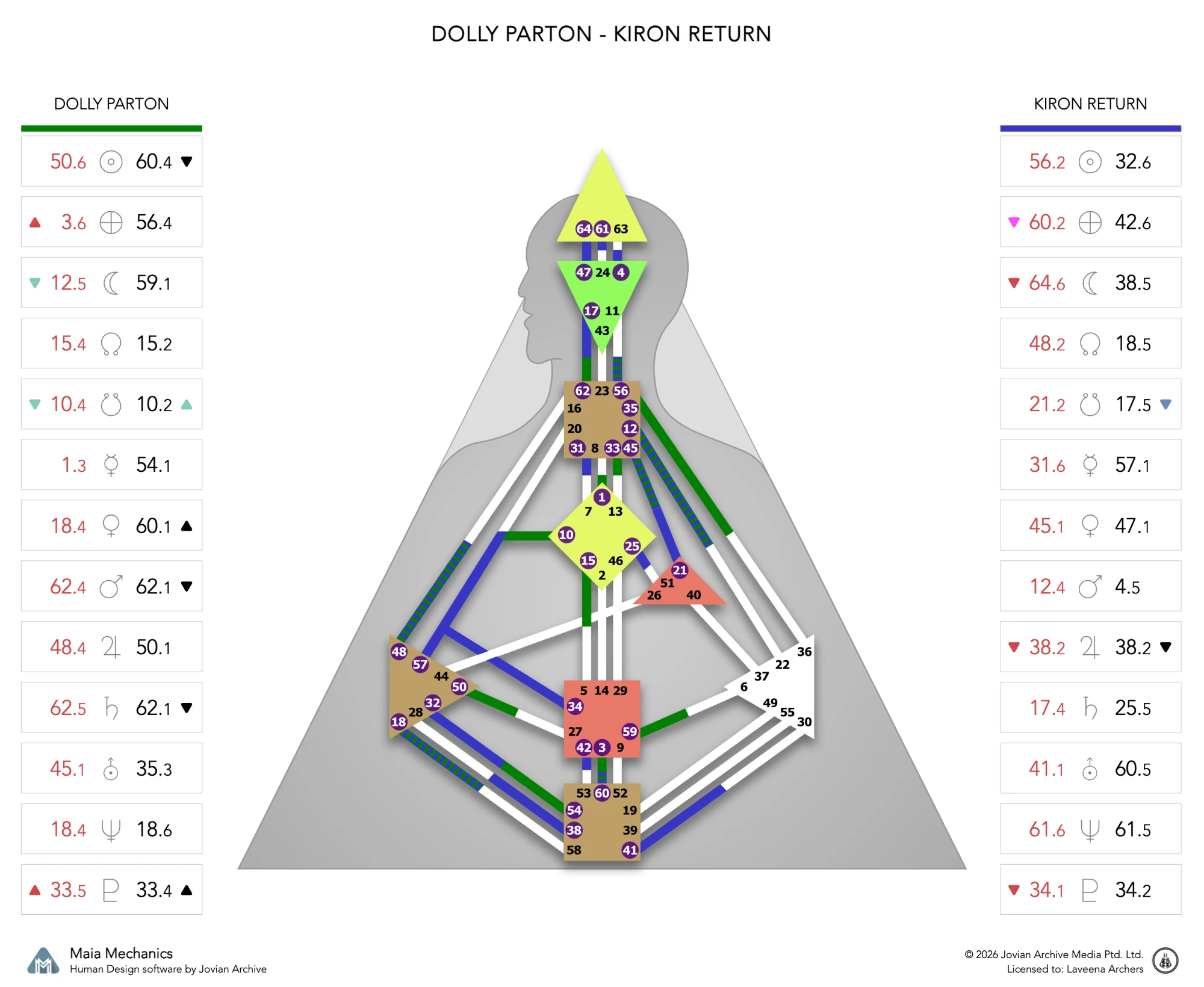
Natal chart against the October 1996 Chiron Return transit, age 50: Chiron transits Gate 32, continuity, a year into the Imagination Library.
Her father, Robert Lee Parton, never learned to read. She’d talked about it for years, the way it had shaped him and shaped the household she grew up in. In 1995, at 49, she founded the Imagination Library in Sevier County, her own home county, mailing a free book a month to every child enrolled from birth to age five. Her Chiron Return landed in October 1996, transiting exactly through Gate 32, continuity, the same gate that senses what has staying power. The timing isn’t a claim that the chart caused the choice. It’s that the wound Chiron came home to visit had already been turned, a year earlier, into the one piece of her legacy built specifically to outlast her: something that has since put more than 300 million books into children’s hands across five countries, as of this week, and is still running tonight.
Fifty is where a 6th-line profile is supposed to step onto the roof, trading the work of living it for the work of being watched living it, and she crossed that threshold almost exactly on time. What’s striking is that she didn’t wait for the roof to open before building; she founded the Imagination Library the year before, at forty-nine, one foot already up the ladder. By now the costume itself had become uniform rather than experiment, the same wig and the same rhinestone silhouette she’d fixed a decade earlier, worn like a role rather than an outfit, which is exactly what a 6th line on the roof does with its own image: stops trying it on and starts simply being seen in it. The Chiron Return that followed didn’t start anything. It confirmed something already begun: the wound of a father who never learned to read, turned a year earlier into the one piece of structure with her name on it built to actually outlive her. This is the Cross of Laws at its core, a job rather than a personality trait, hope organized into a delivery schedule, one book at a time, to children she would mostly never meet.
This particular transit carries its own cross too, not her natal one: the Left Angle Cross of Limitation, on a 6/2 profile. Left Angle crosses run transpersonal rather than personal, the kind of work that depends on other people and circumstances lining up around you rather than on your own effort alone, and Limitation is exactly the conditioning that has to happen first, the boundary a person needs to be shaped by before they’re actually capable of the work their life was for. A 2nd line underneath it is the Hermit, the natural gift that has to be called out rather than volunteered. Read against this exact year, that’s the useful kind of conditioning: a childhood shaped by not having enough, called out into a program built specifically to give other children what she didn’t have. Some limitations turn out to be the training rather than the wound.
Second Saturn Return, 2004–2005
The second Saturn Return, close to fifty-nine, doesn’t test what’s shaky the way the first one does. By then the shaky structures are usually long gone. It tends to arrive instead as ratification: institutions formally agreeing to what individual people already knew.
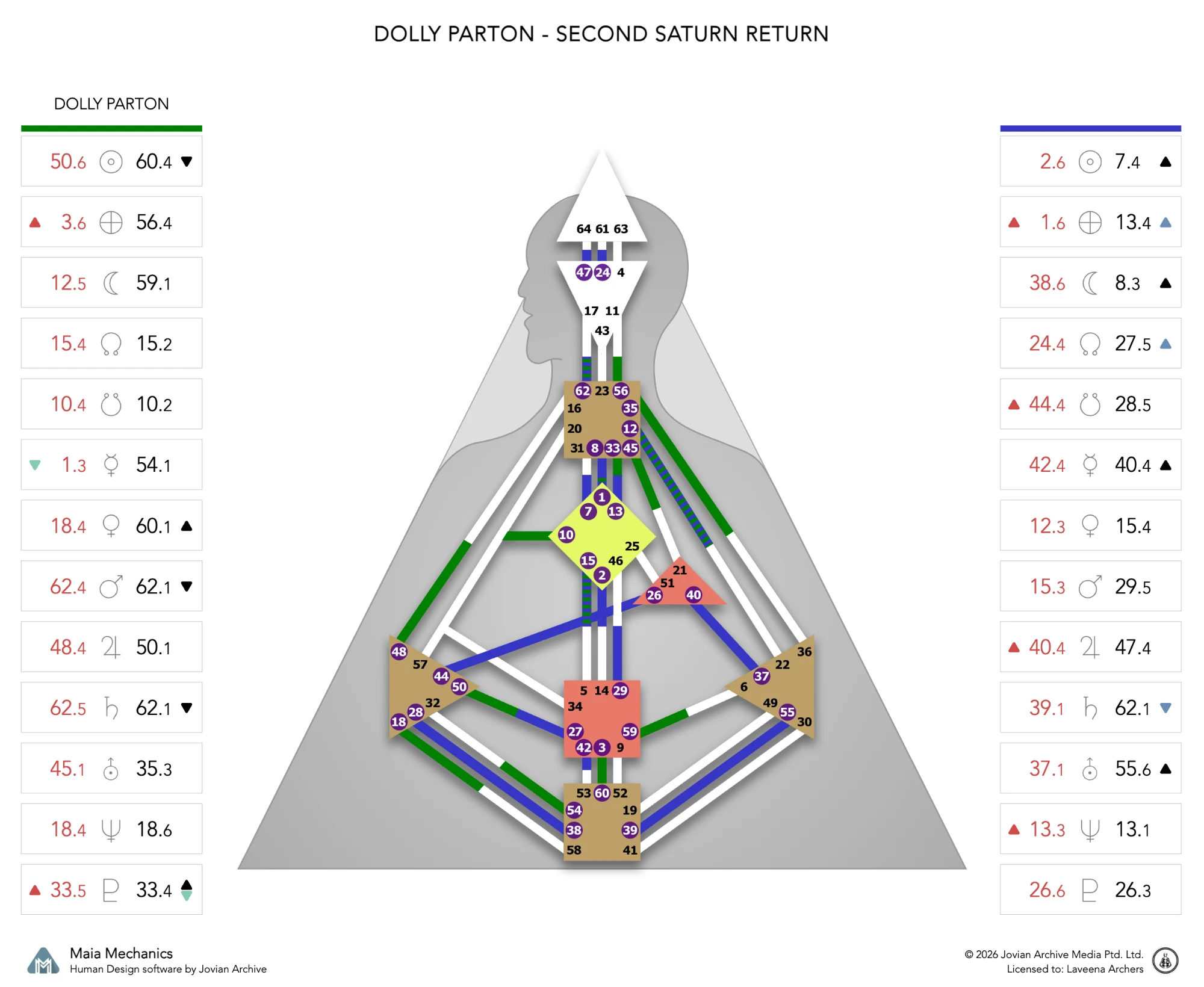
Natal chart against the 2004-2005 second Saturn Return transit, age 58 turning 59: the Library of Congress and the NEA both make it official.
In April 2004, the Library of Congress named her a Living Legend. In 2005, the National Endowment for the Arts gave her its National Medal of Arts. Both landed inside the same second Saturn Return window that closed out that spring. Nothing about either honor was new information about who she was. What changed was the paperwork: the country’s own cultural institutions putting an official seal on a body of work and a body of giving that had already, by then, been running on its own structural integrity for three decades.
By the second Saturn Return she was fully on the roof, past building and into being pointed to, which is the only work a 6th line has left once the roof opens for good. The 4th line’s old trick, influence moving through people already in the room, hadn’t gone anywhere; it had just changed scale, from a TV producer’s living room to the Library of Congress and the National Endowment for the Arts, institutions extending recognition through the same relational fabric that once got her a spot on a regional variety show. Even the costume had made that same leap: no longer just her own signature look, but a fixed piece of American visual shorthand, recognizable in silhouette alone, the kind of image institutions formally catalog rather than critique. The Cross of Laws reached the most literal version of its own job description here: a country formally agreeing, in writing, that what she’d built, image included, qualified as law.
Her health
What she talked about, over the years, fits her design closely. Her Determination is Primary Health System’s read on how a body is actually built to fuel itself, and hers is Thirst: a system built around a specific craving, trusted literally rather than second-guessed. She’s spoken publicly about a hard stretch in her late thirties, a partial hysterectomy and a depression that followed it, years she’s since described as the closest she came to falling apart completely. Recovery, by her own account, came slowly and through people, the way a body actually heals when it’s allowed to trust what it’s asking for instead of overriding it.
Her Environment is Valleys, the setting a body actually settles in rather than merely tolerates, and she never really left hers. Sevierville sits in one; Nashville, where she died, sits in another. Whatever else changed across eighty years and four returns, the physical ground she needed to think and heal on stayed the same ground she started on.
Her Perspective, the other side of Rave Psychology from Motivation, how the mind actually takes in the world rather than what drives it to act, is Wanting: tracking what’s still needed rather than settling into whatever has already been secured. It rarely shows up as a single decision the way a Sacral yes does. It shows up as a refusal to let any finish line count as finished. Dollywood added a new headline attraction every several years across four decades instead of coasting on the 1986 reopening. The Imagination Library, above, kept crossing into new countries long after it had already succeeded in one county in Tennessee, the three hundred million books a number that was never going to be the last number. Wanting doesn’t stop to ask whether the next thing is necessary. It just keeps naming what isn’t there yet.
Her Motivation, the other half of Rave Psychology, was Hope: sustained effort aimed at what’s possible rather than what’s already proven. It shows up as the throughline under everything, the rhinestones and the wig jokes she told about herself before anyone else could, the direct kindness, the refusal to be cynical in an industry that rewards cynicism, and it showed clearest in the last years of her life. In April 2020, with no vaccine yet in existence and no guarantee one would work, she donated a million dollars to Vanderbilt for COVID-19 research, money Vanderbilt later confirmed helped fund early work on what became the Moderna vaccine. In March 2021, she filmed herself taking that vaccine on camera, and rewrote a verse of one of her own songs for the occasion to make the point land, a public moment she wrote herself to get other people to act rather than to take a bow. Hope, mechanically, is fuel that keeps working when the outcome is still years out, a different animal from optimism. She spent it for eighty years and it did not run dry before she did.
Her family’s own statement is what this section leans on, not speculation: “After bravely facing a brief battle with cancer, Dolly departed her Earthly life today at the Vanderbilt-Ingram Cancer Center surrounded by loved ones.” She’d canceled a Las Vegas residency in September 2025 to deal with what she called “health challenges” at the time, without saying more. Nearly a year later, she was admitted to Vanderbilt on August 21, 2026, and died four days after that, on the 25th. She never disclosed the cancer diagnosis publicly before her death, and I’m not going to guess at what she chose to keep private. Both things were apparently true about her at once: raising a million dollars a year ahead of proof, and keeping her own diagnosis to herself. Design doesn’t resolve that tension. It just names where it was sitting.
What her design leaves behind
She’d lost her husband, Carl Dean, a year and a half earlier; he died in March 2025, after nearly sixty years of a marriage she kept almost entirely out of the public eye, the one part of her life that was never quite anyone else’s story to tell. They met the day she arrived in Nashville in 1964, outside a laundromat, and married two years later in a small ceremony almost nobody else attended. Single Definition doesn’t need a partner to feel whole, and I think that’s exactly why the one relationship she did choose got guarded so completely: not a piece missing that he filled in, but a yes she gave freely and then spent six decades protecting from an industry that would have turned it into content. She outlived him by seventeen months.
I remember my own blonde mother singing along to Dolly fondly, and I don’t think that was a rare thing to witness. Kindness was never incidental to what she built; it was the actual material. She was famous for the way she treated people who could do nothing for her, the crew members she remembered by name decades later, the strangers she paid hospital bills for without a press release attached. That’s a harder legacy to leave than a catalog, because you can’t chart it or copyright it. It just gets passed down anyway, mother to daughter, generation to generation, in the people who decide to be a little more like her.
Laid side by side, none of these mechanics are separate stories. A Sacral yes that needed no argument. A Single Definition needing no partner to feel complete. A Thirst that trusted a specific craving literally, and a Wanting that kept tracking what was still needed. A fourth line that built through the people already in the room, and a sixth line that spent thirty years testing before it ever stepped onto the roof. A Cross of Laws turning whatever her Sacral said yes to into something a whole community could keep standing on after she was gone. Read one at a time, they sound like eight different traits. Read together, they’re one throughline: something private and certain, trusted immediately, then built out into something public and permanent. That throughline is the actual shape of the life.
Her chart’s signature is Satisfaction, and its not-self is Frustration, and that’s the actual measure here, not sainthood. A Sacral Generator either builds a life from real response and feels the satisfaction of work correctly done, or it initiates from the mind instead and spends its energy on frustration that never quite resolves. She isn’t a saint in this reading. She’s a working example of the first path held for eighty years: response before initiation, most of it in public, most of it on the record. Most of us spend years learning to let a gut response outrank a good argument. She did it on camera starting in her twenties, and built a life nobody else could have designed for her because it wasn’t designed. It was responded to, one yes at a time, straight through four returns and eighty years.
Her last years carried the same Channel 3-60 pulse that had marked every major turn: long stretches of quiet pressure, then sudden, irreversible change. The immune and digestive difficulties she named in 2026, the canceled residency, and the brief cancer battle that followed read less like random misfortune and more like Gate 60 finally collecting its due—the acceptance of a hard limit after decades of building inside every constraint life handed her. A 4/6 on the roof does not fight the end of the experiment; she simply stops performing it. Some researchers, including MIT scientist Stephanie Seneff, have proposed a possible mechanistic overlay for rapid-onset malignancies in people with prior immune complaints: mRNA vaccination can drive thymic involution and a Treg/Teff imbalance that either unleashes autoimmunity or allows existing cancer cells to progress, depending on the person’s immune status at the time (see Kyriakopoulos, Nigh, McCullough & Seneff, “Autoimmune and Neoplastic Outcomes After the mRNA Vaccination: The Role of T Regulatory Cell Responses,” International Journal of Vaccine Theory, Practice, and Research 3(2), 2024, https://doi.org/10.56098/16j4nf05). Whether that framework applies here is unknowable—the cancer type was never disclosed and later vaccination details are not public—but it sits beside the chart as one more layer some students of both Design and biology will want to hold. The sacral that had answered “yes” to Wagoner, to Dollywood, to a million books, and to one last public shot she hoped would help people trust something larger than herself had, by August, no more yes left to give. What remains is the structure she left behind, exactly as the Cross of Laws is designed to do.
Her family has asked that anyone wanting to honor her make a donation to the Imagination Library in lieu of flowers, which is on-brand for everything above: even in grief, the ask is for the structure that outlasts the moment, not the moment itself.
Chart via myBodyGraph, rendered through MaiaMechanics and Jovian Archive software, birth data via Astro-Databank. Biographical and business dates cross-checked against Britannica, the Tennessee Encyclopedia, Biography.com, the Library of Congress, and the National Endowment for the Arts. Reporting on her death and its cause via her family’s own statement as carried by NPR, CNN, Variety, and the Today show; the Imagination Library’s current reach via the program’s own site. If you want the business-mechanics half of this same chart, that’s the companion piece: Dolly Parton, Human Design, and the Business She Built on HumanDesignBusiness.com.
If you want to see what your own design would ask you to trust the way she trusted hers, your chart is free. It won’t make you the unique example of Dolly Parton. It will show you the context of your life’s movie where you play the starring role, and the way to experiment with your human design and discover how you can trust your own yes.
See this in your own chart
Generate your free bodygraph and start your own experiment.
Get My Free HD Chart