The Ajna Center in Human Design
Everyone you’ve ever argued with about being right was, in that moment, living from their Ajna. So were you.
The Ajna is the mind’s workshop: the awareness center that turns raw mental pressure into concepts, opinions, insights, and beliefs. It’s where information gets organized into something you can rely on, or something you white-knuckle because letting go feels like chaos.
The mechanics: awareness between two worlds
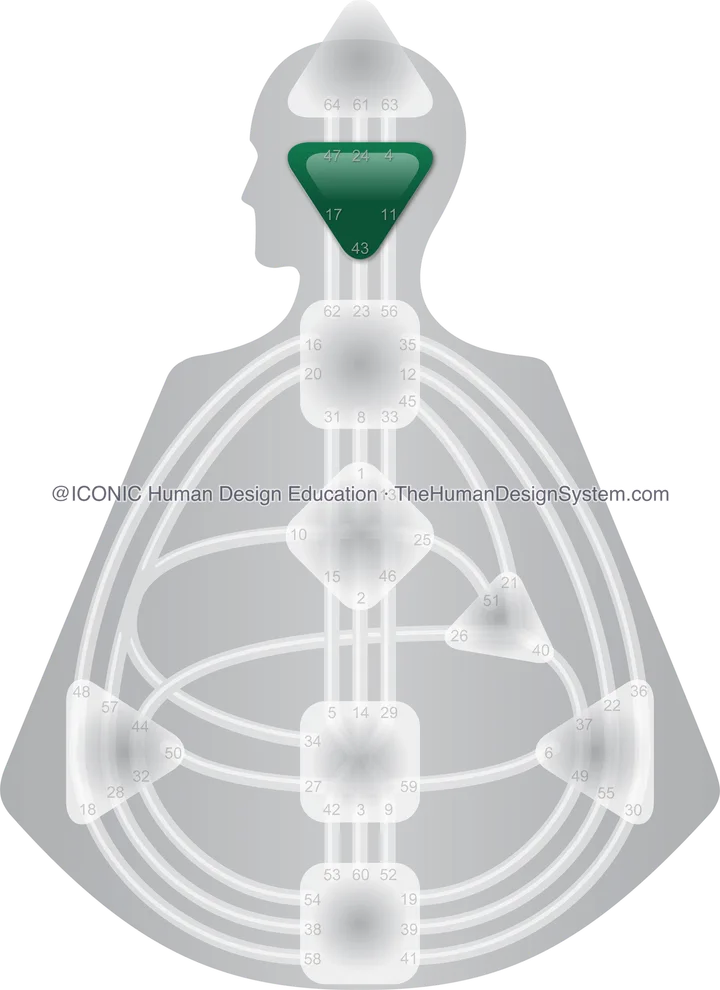
The Ajna sits between the Head above and the Throat below, and it’s the only awareness center wired to both a pressure source and an expression outlet. It holds six gates: 4, 11, 17, 24, 43, and 47.
From above, the channels 63-4 (Logic), 64-47 (Abstraction), and 61-24 (Awareness) convert Head pressure into three distinct styles of thought: answers to be tested, experiences to be made sense of, and knowing that arrives whole. From below, 17-62 (Acceptance), 11-56 (Curiosity), and 43-23 (Structuring) carry opinions, ideas, and insights to the Throat for expression.
As an awareness center the Ajna runs its own species of unease, and it is not the Spleen’s. Where splenic fear is immediate and physical, the Ajna produces anxiety — one per gate: challenge (17), rejection (43), darkness (11), chaos (4), ignorance (24) and futility (47). Mental certainty is largely a defense against it, which is why it is defended so much harder than the evidence warrants.
Defined Ajna: a reliable way of making sense
With a defined Ajna, your conceptual machinery runs the same way every day. Depending on your definition, you may be a lifelong pattern-tester, a storyteller who processes life in hindsight, or someone whose insights arrive as sudden, hard-to-explain knowing. This consistency is genuinely valuable: people can trust how you think.
The shadow is fixity. A defined Ajna can defend a concept long after the evidence has left the building, because admitting uncertainty feels structurally uncomfortable. And it makes the loudest false claim in the bodygraph: I should decide. However brilliant, a defined mind is still not an inner authority. It’s an outer authority, superb at thinking things through for others, at research, at communication, while your own decisions belong to the body.
Undefined and open Ajna: fluid mind, borrowed certainty
An undefined Ajna has no fixed way of processing. Around logical minds you think logically; around abstract minds you think in stories. That fluidity is the raw material of real intellectual wisdom, the capacity to evaluate many styles of thinking without being trapped in one.
The not-self question here is: am I pretending to be certain? Under conditioning, the undefined Ajna grabs opinions and grips them, because “I don’t know” feels dangerous in a world that rewards confident answers. It memorizes positions, quotes authorities, and argues hardest exactly where it’s least sure.
A completely open Ajna (no gates activated) can feel this most acutely, struggling to hold fixed concepts at all, and either faking conviction or feeling stupid for its flexibility. It isn’t stupid. It’s potentially the wisest mind in the room about how people think, once it stops needing to be certain. “I could be wrong” is not weakness for this design; it’s accuracy.
The six gates of the Ajna
- Gate 4, Formulization: answers as hypotheses, awaiting testing.
- Gate 11, Ideas: a constant stream of ideas and imagery, meant to be shared, not all acted on.
- Gate 17, Opinions: structured views on how things could work better.
- Gate 24, Rationalization: the mind circling back to make peace with what it knows.
- Gate 43, Insight: unique inner knowing seeking a form others can grasp.
- Gate 47, Realization: meaning assembled from lived experience, in its own time.
Human Design anatomy
Human Design gives the Ajna the pituitary, the gland that directs so much of what the other glands do, and the center’s six gates resolve into three streams that each begin as pressure in the Head and end as speech in the Throat. The Understanding stream runs doubt into judgment into opinion into detail (63, 4, 17, 62). The Knowing stream runs the pressure of mystery into rationalization into insight into assimilation (61, 24, 43, 23). The Sensing stream runs confusion into realization into ideas into stimulation (64, 47, 11, 56). All three do the same job in different currencies: take pressure from above, make sense of it, hand it to a voice. And a gland that directs is still not a gland that decides. The Ajna organizes; your authority chooses.
Structurally the Ajna is the odd one out. Three gates face up to the Head, three face down to the Throat, and nothing goes sideways: it is the one center in the bodygraph with no lateral connections at all. A sealed conduit between pressure and voice, which is exactly why it can neither act nor decide — there is no motor it can reach and no route to the body. Its Knowing stream is also what this system calls the inner ear, the hearing that is not sound: thought arriving as though overheard, which is why insight in this center so often feels received rather than produced.
Living it
The Ajna at its best is a beautiful instrument: measuring, comparing, articulating. It goes wrong only when it’s promoted to CEO. Let your mind entertain, research, and advise, and let your body’s authority sign the contracts. If you have Ajna definition without a defined Throat-motor connection, this distinction is the difference between mental peace and a lifetime of second-guessing.
Curious whether your Ajna is defined, and how your mind is built to process? Run your free chart. And when you’re ready to see how mind and authority divide the labor in your specific design, a Foundational Analysis walks you through it.
Whichever of the eleven bodies your own chart places in this center's gates adds its function here, for you specifically: see the Design Lunar & Planetary Square.
A framework for self-understanding, not a medical claim. See the full note on medical astrology and Human Design.
Frequently asked questions
What is the Ajna center in Human Design?
The Ajna is one of the three awareness centers in the bodygraph, responsible for mental awareness: conceptualizing, analyzing, forming opinions, and making sense of information over time. It sits between the Head and the Throat and holds six gates: 4, 11, 17, 24, 43, and 47. Defined or not, it is never a correct decision-making authority.
What does a defined Ajna mean?
A defined Ajna means you have a fixed, consistent way of processing information, whether logical, abstract, or individual knowing, depending on your channels. Your concepts are reliable, and certainty comes naturally. The trap is rigidity: mistaking your consistent way of thinking for the truth, and using mental certainty to override your actual inner authority.
What does an undefined Ajna mean?
An undefined Ajna processes information in variable ways depending on who's around, which makes it mentally flexible and potentially deeply wise about ideas. The conditioning theme is pretending to be certain, clinging to fixed opinions and beliefs to feel mentally secure. Healthy openness sounds like 'I could be wrong,' and enjoys ideas without needing to defend them.
Can you make decisions with the Ajna?
No. In Human Design the mind is an outer authority, brilliant for research, communication, and weighing concepts for others, but it is not an inner authority for your own life. Even people with a fully defined Head and Ajna decide correctly through their body's authority, such as emotional, sacral, or splenic awareness. The mind measures; it doesn't choose.