The Collective Sensing (Abstract) Circuit in Human Design
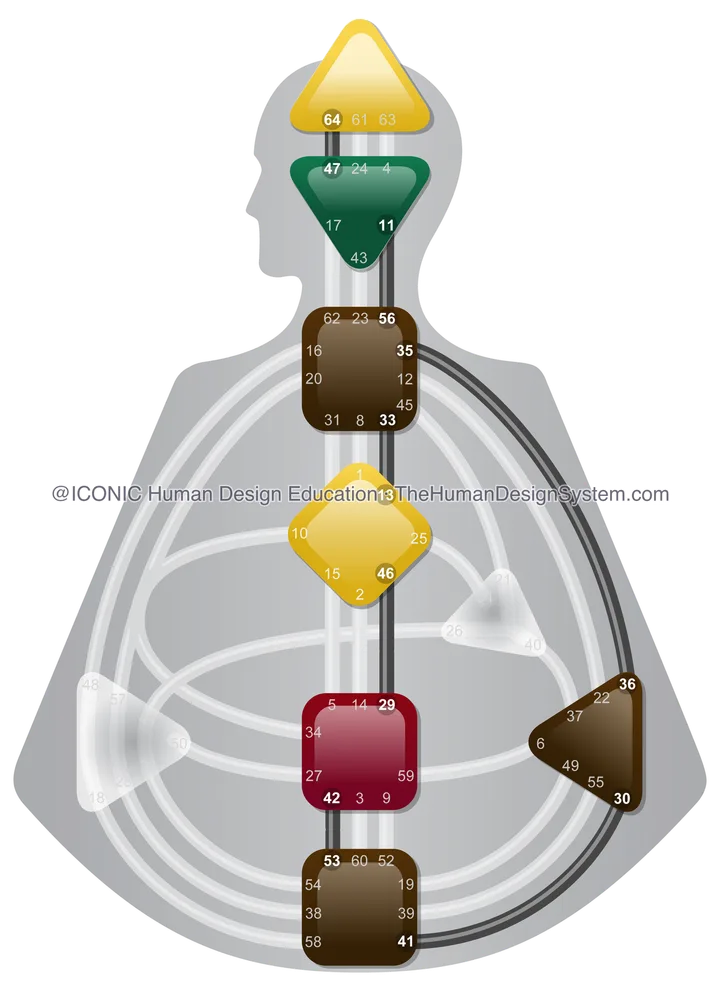
Some knowledge cannot be handed over as a rule. It has to be lived first, and even then it only really transmits as a story, a feeling, a “this is what it was actually like.” That is the Collective Sensing circuit, more commonly called Abstract: seven channels built for experiencing life, then sharing what it meant.
What Collective circuitry is for
Collective circuits share with the world at large — anyone, not the immediate tribe and not only the self. What gets shared is different depending on which half of the family’s channels you carry. Sensing shares felt experience: curiosity followed all the way through, a story worth telling, meaning discovered rather than calculated. Collective Understanding (Logic), the family’s other circuit, shares something else instead: analysis, pattern, and fixed process.
The seven channels
- 11-56 Curiosity — ideas gathered and turned into a story worth telling.
- 30-41 Recognition — feeling drives the desire to try something new, whatever it turns out to be.
- 33-13 The Prodigal — a personal past retold as a lesson for whoever needs to hear it.
- 35-36 Transitoriness — experience sought for its own sake, then let go once it has been fully felt.
- 42-53 Maturation — a cycle carried all the way to completion, not abandoned partway through.
- 46-29 Discovery — commitment to being in the body and in the moment, wherever that moment leads.
- 64-47 Abstraction — confusion sat with long enough that it resolves into sudden clarity.
Living an experience-first circuit
The channels here do not skip to the conclusion. They want the actual experience, the full one, including the parts that are confusing or uncomfortable while they are happening, because the meaning genuinely is not available any other way. Trying to shortcut that — to extract the lesson before living the thing that produces it — tends to leave this circuit with nothing real to share.
The corresponding gift is a kind of teaching nobody else can offer quite the same way: not advice handed down, but an account of having actually been there, which lands differently precisely because it is not abstract in the ordinary sense of the word. It is abstracted meaning, pulled out of something real.
To see whether any of these seven channels are part of your own definition, get your free chart. A professional reading will show you how your Collective circuitry, if you carry it, is built to share.
Every channel in the Collective Sensing (Abstract) circuit
Frequently asked questions
What is the Collective Sensing (Abstract) circuit in Human Design?
Collective Sensing, also called the Abstract circuit, is one of two circuits in the Collective family, built from 7 channels. Its theme is sharing experience with people outside your immediate tribe: learning by living through something, then passing on what that experience actually felt like, so others can benefit without repeating it themselves.
Why is it also called Abstract?
Because the knowledge it carries is not a fixed procedure. It is felt, remembered, and told, closer to story than to instruction manual, and it changes shade depending on who is telling it and what they actually lived through. That is what distinguishes it from the Collective family's other circuit, Understanding (Logic), which shares knowledge through fixed, testable analysis instead.
Which channels make up Collective Sensing (Abstract)?
Seven: 11-56 (Curiosity), 30-41 (Recognition), 33-13 (The Prodigal), 35-36 (Transitoriness), 42-53 (Maturation), 46-29 (Discovery), and 64-47 (Abstraction). Between them they cover curiosity, storytelling, the completion of an experience, and the meaning drawn out of it afterward.
Is Collective Sensing the same as Collective Understanding (Logic)?
No, though both belong to the Collective family and both share with the wider world rather than the tribe. Sensing shares through lived experience and feeling. Logic shares through analysis and pattern. One teaches by telling you what it was like; the other teaches by explaining how it works. See the Collective Understanding (Logic) circuit for the second half of the family.