What Human Design Actually Inherited From Kabbalah
Ra named Kabbalah as one of the four streams in the synthesis. Here is what the bodygraph really took from it: the body as microcosm, and tzimtzum as the mechanic behind openness.

Ra named four ancient streams feeding the synthesis, and Jovian Archive still lists them: the I Ching, astrology, the Hindu-Brahmin chakra system, and the Kabbalistic Tree of Life. Three of those you can trace on sight. The hexagrams are around the wheel, the planets are down both sides of the chart, the nine centers are visibly chakras redrawn. Kabbalah is the one nobody can point to, and so in most tellings it stays a one-line credit that nothing depends on.
It deserves better, because what the bodygraph took from Kabbalah is not a symbol. It is a logic, and once you can see it, two of the most misunderstood ideas in the system stop being consolations and start being mechanics.
The move that matters is the body as diagram
Look at what Lurianic Kabbalah does with the sephirot. It does not leave them as an abstract ladder of divine attributes. It arranges them in the shape of Adam Kadmon, the primordial human: right arm expansive, left arm restrictive, a middle column of balance running crown to foundation. The claim is that cosmic structure and human anatomy are the same structure at two scales. The tree is not a thing you look at. It is a thing you are.
That is the inheritance. The bodygraph makes the identical move in a modern register: a diagram of cosmic mechanics drawn as a body, with pressure at the crown, a motor at the base, and a central column of identity between them. Set the two side by side and the anchors land without forcing. The G Center sits where Tiferet sits, the harmonizing heart of the structure and the seat of identity and direction. The Head crowns the form the way Keter does, taking pressure from beyond the system. The central column runs where the middle pillar runs, flanked left and right by asymmetric powers.
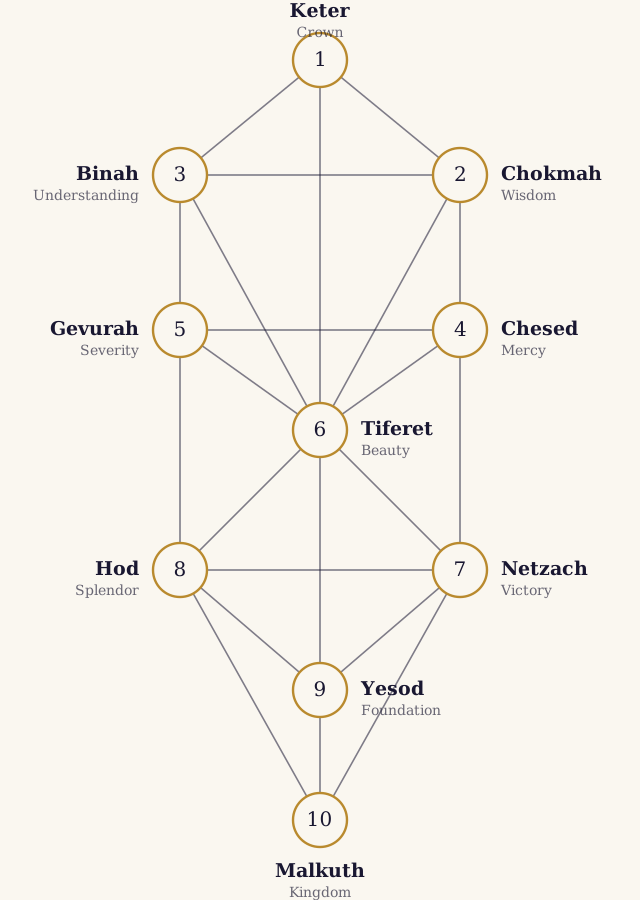
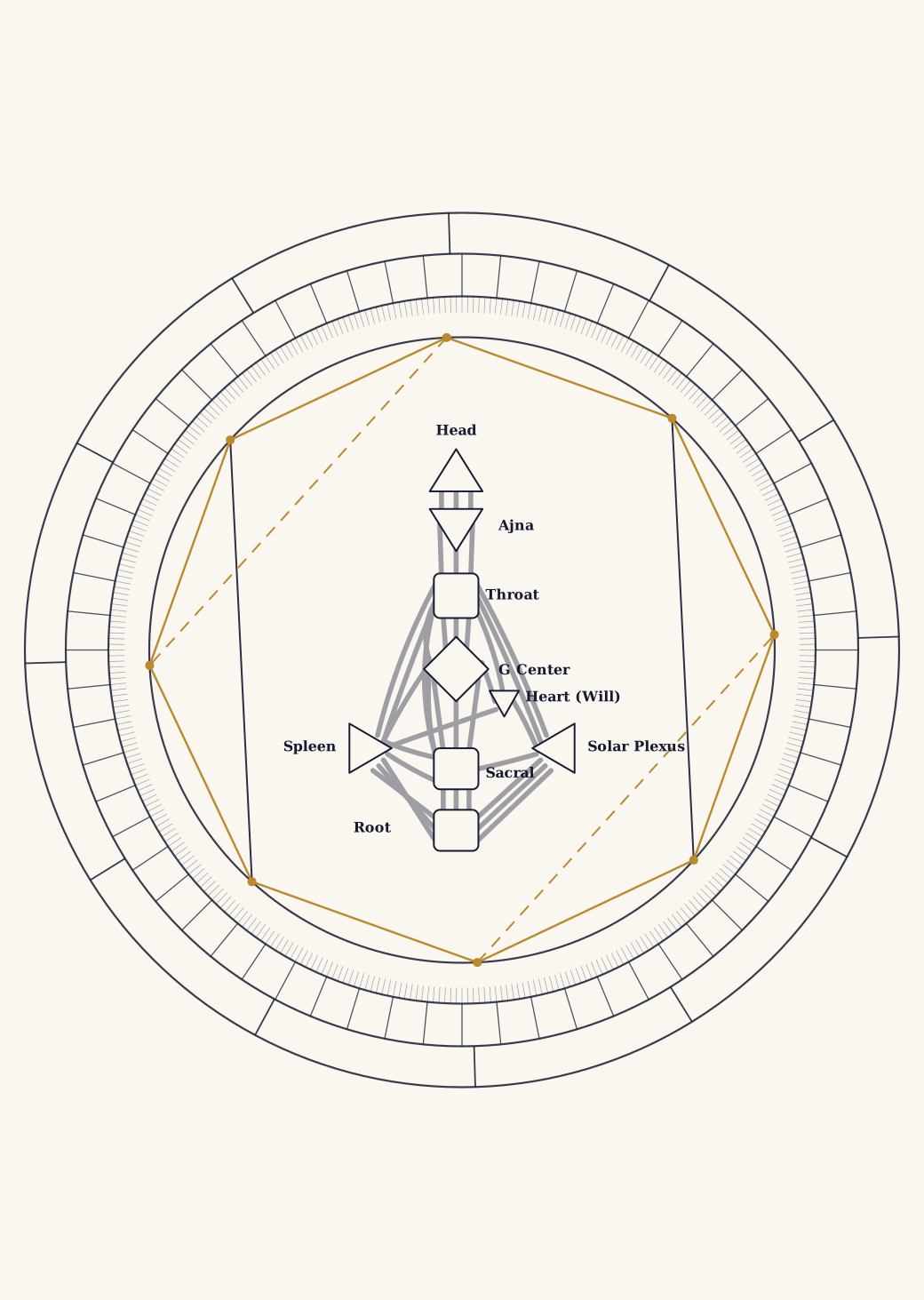
This is where popular writing overreaches. Nine centers is not ten sephirot. Thirty-six channels is not twenty-two paths. The bodygraph is not a cipher of the Tree, and any mapping that claims every piece lands is selling you something. What carried over is the underlying logic, the microcosm claim and the pillared body, not a correspondence table. Human Design is its own synthesis. Trace the inheritance; do not claim the equivalence.
Tzimtzum, and why openness is not a deficit
This is the one that changes how you read your own chart.
Kabbalah’s most radical idea, which reaches us through Isaac Luria’s two years of teaching in sixteenth-century Safed, is its account of how a finite world can exist at all. If the Infinite fills everything, there is no room for anything else. So the first creative act is not expansion. It is withdrawal. The Infinite contracts away from a point, opening what the kabbalists called a vacated space, and only into that emptiness can something that is not God stand up and exist. Creation begins with a deliberate act of making room.
Now read your chart again. Definition is what the imprint filled in: consistent, reliable, yours, running whether you attend to it or not. Openness is the vacated space. And the whole not-self drama of a life comes from treating that space as an absence, something missing that ought to be filled, a deficiency to be corrected by effort or apology.
The kabbalistic reading says the opposite, and says it structurally. The vacated space is not where you are lacking. It is the only place where anything other than you can enter. Openness is the condition of receiving at all. An open center is not a hole in your design; it is the aperture through which the world reaches you, gets amplified, and becomes something you can eventually be wise about. Nothing enters a full vessel.
The tradition even supplies the vocabulary for conditioning. When the light withdrew, it left a residue behind in the emptied space, the reshimu, which the texts describe as the scent of wine remaining in a glass that has been poured out. That is a precise description of what an open center carries away from every aura it spends an evening beside. Deconditioning, in this vocabulary, is not scrubbing yourself clean. It is the patient work of sorting residue from essence: learning, over years, which impressions are actually yours and which are the scent of someone else’s wine.
Form is written
There is a second, quieter inheritance. The oldest text in this stream, Sefer Yetzirah, teaches that creation is combinatorial: God makes by engraving and weighing and permuting an alphabet, and everything that exists is a combination of letters. Reality, on this account, is written.
Human Design takes that intuition and runs it into biology, binding the 64 gates to the 64 codons of the genetic code and reading a life as something spelled out in a fixed alphabet. A medieval kabbalist permuting letters to touch the engine of creation and a modern analyst reading gate keynotes as genetic vocabulary are seven centuries apart and holding the same conviction: the world is a text, and a human being is a passage in it.
The shape of a cycle change
One more, and this one is a lens rather than a mechanic, so hold it loosely.
Ra taught that the 19/49, the tribal bargain of mutual support that has run as background frequency through this era, does not survive the 2027 cycle change. Read that as a forecast and it sounds like collapse. Kabbalah has an older grammar for this exact shape of event: a configured world reaches the limit of what its vessels can hold, the configuration shatters, and the shattering is not punishment but the necessary prelude to a structure capable of carrying different light. Shevirah before tikkun. Breaking before repair.
It is a way of holding a structural change without reading every crack as a catastrophe, which is a useful thing to have in hand over the next few years.
Living it
None of this requires you to take on a religious tradition, and I should say that Kabbalah is a living Jewish practice embedded in Torah, prayer, and Hebrew, not a set of metaphors sitting around waiting to be borrowed. What travels is the structural insight, and it earns its place because it makes a mechanic legible. If you want the tradition on its own terms, with the real history sourced and the folklore labeled as folklore, I have written that up separately as a full guide to Kabbalah.
The part to test is tzimtzum. Pull up your chart, find your open centers, and for two weeks stop treating them as your weak spots. Treat each one as an aperture instead, and note what comes through it and whose it turns out to be. That single reframe does more practical work than any correspondence table.
If you have not mapped your definition yet, run your free chart first and see where your own vacated space sits.
See this in your own chart
Generate your free bodygraph and start your own experiment.
Get My Free HD Chart