The Tribal Defense Circuit in Human Design
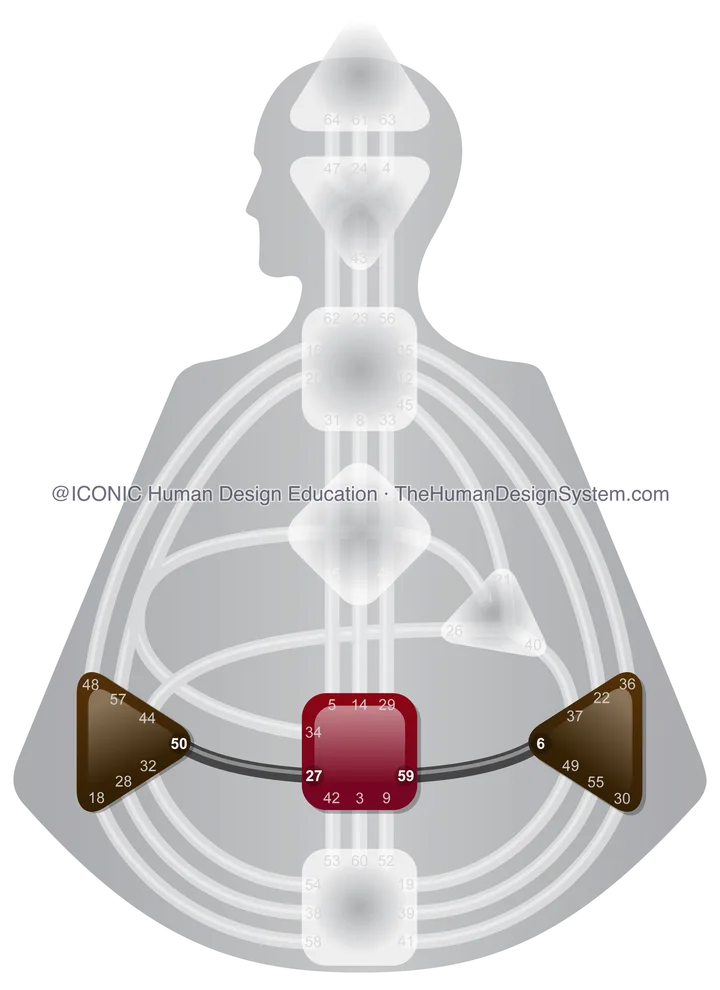
Two channels, and between them they cover most of what keeps a tribe alive across time: who takes care of whom, and who bonds closely enough to carry the group forward. That is the Tribal Defense circuit.
What Tribal circuitry is for
Tribal circuits answer to the immediate group rather than to the self or the wider collective, trading in support given and received. Tribal Ego, the family’s other circuit, provisions the tribe materially, through willpower, bargains, and resources. Defense does something different: it protects the tribe and perpetuates it, through caretaking and through the intimate bonds that hold a community together over the long run.
The two channels
- 27-50 Preservation — nurturing, and the guardianship of the values a tribe considers worth protecting.
- 59-6 Mating — the drive toward intimate bonding, the closeness that perpetuates a tribe rather than merely supplying it.
Living with a caretaking circuit
This is a small circuit carrying a heavy job. Preservation asks who needs looking after and makes sure it happens. Mating asks who is worth bonding closely with, and pushes toward the kind of intimacy that a tribe cannot survive without. Neither channel is subtle when it is triggered: care and closeness both tend to arrive as strong, immediate pulls rather than considered decisions, because an immune system does not deliberate before it responds.
The corresponding challenge is boundary, not intensity. A circuit built to protect and to bond will not naturally know where the tribe ends and everyone else begins, and living it well usually means learning, deliberately, who actually falls inside that circle.
To see whether either of these two channels is part of your own definition, get your free chart. A professional reading will show you exactly how your Tribal circuitry, if you carry it, is built to protect.
Every channel in the Tribal Defense circuit
Frequently asked questions
What is the Tribal Defense circuit in Human Design?
Tribal Defense is one of two circuits in the Tribal family, built from 2 channels. Its theme is protection: caring for the vulnerable and bonding intimately enough to perpetuate the group. Where Tribal Ego provisions the community materially, Defense protects it and carries it forward.
Why is it called Tribal Defense?
It functions like an immune system for the group: identifying who needs care, extending it, and forming the close bonds that hold a tribe together across generations. That combination of caretaking and intimacy is what keeps a tribe alive and able to defend itself, not just materially provided for.
Which channels make up the Tribal Defense circuit?
Two: 27-50 (Preservation), which carries nurturing and the tribal values worth protecting, and 59-6 (Mating), which carries the drive toward intimate bonding. Together they are the smallest Tribal circuit and the second-smallest of all seven, after Individual Centering.
Is Tribal Defense only about physical protection?
No. Preservation is as much about values and care as it is about physical safety, and Mating is about bonding and intimacy generally, not only its biological sense. The circuit is closer to a caretaking-and-connection system than a literal security detail.