The Tribal Ego Circuit in Human Design
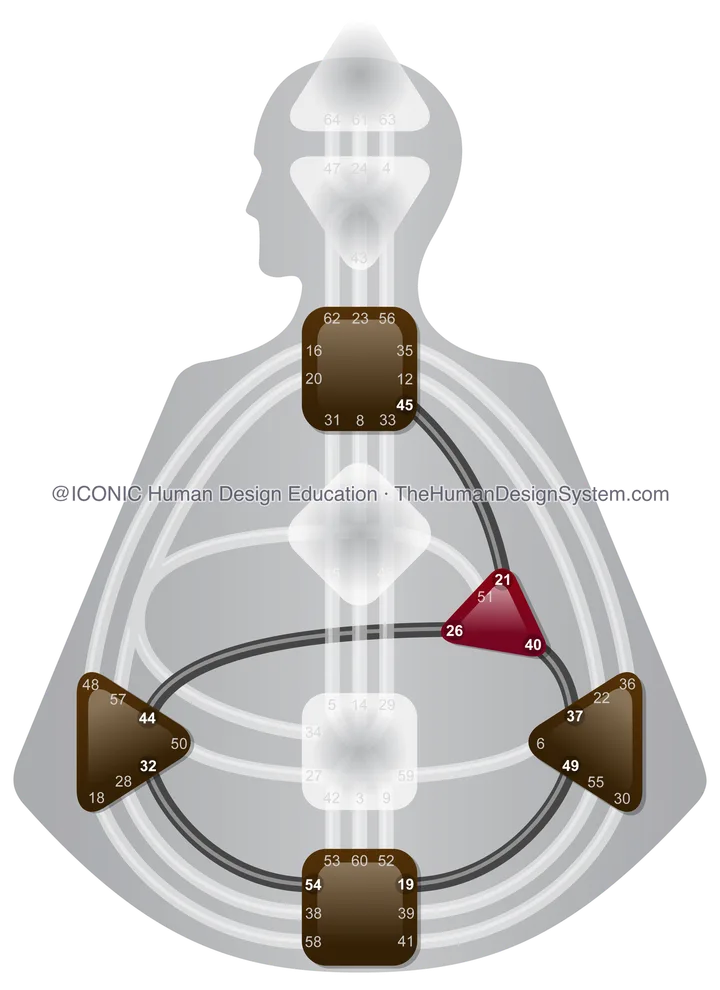
Every group of people who rely on each other needs someone willing to make the deal, keep the promise, and show up for the work that keeps the lights on. That willingness is the Tribal Ego circuit: five channels of willpower spent squarely on the material world the tribe actually lives in.
What Tribal circuitry is for
Tribal circuits answer to the immediate group — family, close community, whoever you would call your own people — rather than to the self alone or to the wider collective. Their currency is support: resources given and received, promises made and kept, protection extended and returned. Tribal Defense, the family’s other circuit, protects the group. Ego provisions it, through willpower turned toward bargains, ambition, and the honest keeping of one’s word.
The five channels
- 26-44 Surrender — persuasion and instinct working together, closing a deal that is actually sound.
- 32-54 Transformation — ambition that will climb whatever ladder is in front of it, in service of the tribe’s standing.
- 40-37 Community — belonging earned through mutual give and take, not assumed for free.
- 45-21 Money — the material leadership that controls and distributes tribal resources.
- 49-19 Synthesis — sensitivity to what the tribe actually needs, and the principled response to it.
Living with willpower on loan to the group
With this circuit’s channels defined, willpower is not an unlimited resource, and this circuit knows it. Every channel in it is transactional in the honest sense: a fair exchange, a kept promise, a bargain that holds up. That is a strength when the deals are sound and a genuine cost when this circuit gets talked into promising more than the willpower behind it can actually deliver. Gate 21’s drive to control resources and Gate 45’s material leadership both need real resources to lead, not aspirational ones.
The tell that this circuit is running well is simple: agreements get kept, and the people around you can feel the difference between someone who bargains in good faith and someone who does not. The tell that it is being conditioned is exhaustion from promises made to please rather than promises the willpower can actually back.
To see whether any of these five channels are part of your own definition, get your free chart. A professional reading will show you exactly how your Tribal circuitry, if you carry it, is built to provide.
Every channel in the Tribal Ego circuit
Frequently asked questions
What is the Tribal Ego circuit in Human Design?
Tribal Ego is one of two circuits in the Tribal family, built from 5 channels. Its theme is willpower directed at resources: earning, bargaining, promising, and delivering, all in service of the people closest to you. Where Tribal Defense protects the group, Tribal Ego provisions it.
Why is it called Tribal Ego?
Tribal circuitry answers to the immediate community rather than to the self or the wider world. Ego, in Human Design, is willpower and the heart's drive to prove its word: the force that shows up to work, keeps promises, and negotiates the deals a tribe actually runs on. This circuit is that willpower turned outward, toward the group's material survival.
Which channels make up the Tribal Ego circuit?
Five: 26-44 (Surrender), 32-54 (Transformation), 40-37 (Community), 45-21 (Money), and 49-19 (Synthesis). Between them they cover bargaining, ambition, belonging, resources, and the sensitivity that knows when a deal is fair.
Is Tribal Ego the same as being materialistic?
No. This circuit is about the mechanics of provision, not about greed. A tribe that cannot feed, house, and fairly compensate its own people does not survive as a tribe. Tribal Ego is the machinery that makes sure it can, and when this circuit's channels are defined and correctly used, it is generous rather than grasping.